Norway is one of Europe’s most attractive markets for international projects. Strong purchasing power, stable infrastructure, and a well-functioning legal and financial system make it a serious option for engineering firms, technology companies, construction contractors, and professional services businesses looking to expand beyond their home markets.
But Norway is also a jurisdiction with strict compliance standards. Foreign companies that underestimate the administrative side — accounting, VAT, payroll, and reporting — often create problems that are far more costly and time-consuming to fix than they would have been to prevent.
This guide explains the key accounting, VAT, payroll, and compliance issues foreign companies should clarify before starting a project in Norway.
For many foreign companies, the risk is not only penalties. The bigger commercial risk is losing control of the project: delayed invoicing, unclear cost allocation, payroll uncertainty, and management teams that do not know whether the Norwegian assignment is actually profitable.
Why Accounting Should Be Handled Before the Project Starts
Many international companies treat accounting as something to sort out after the project is running. In Norway, this is a mistake that can be expensive.
Poor accounting setup creates a cascade of problems: incorrect VAT treatment, late payroll reporting, undocumented costs, and unclear project profitability. Tax authorities in Norway expect documentation to be in order from the start — not reconstructed after the fact.
Bookkeeping in Norway is not just a year-end formality. Norwegian requirements demand structured, ongoing documentation with clear traceability. A foreign company that starts operating without establishing proper routines will quickly accumulate a backlog that no accountant can easily untangle.
The time to engage a Norwegian accounting firm is before the project starts — not when the first invoice needs to go out.
Do You Need to Register Your Business in Norway?
Registration requirements for foreign companies in Norway depend on multiple factors: the nature of the activity, the duration of the assignment, whether employees are sent to Norway, and what kind of income is generated.
Doing business in Norway without the appropriate registrations can create tax exposure and penalties that exceed the value of the work itself. A foreign company in Norway may need to register in the Central Coordinating Register for Legal Entities (Brønnøysundregistrene), register for VAT, set up payroll reporting, and in some cases establish a Norwegian branch entity (NUF) depending on the extent and duration of the activity.
These obligations should be assessed before the project begins. They are not uniform — a short consulting assignment has a different profile than a 24-month construction contract. An early conversation with a Norwegian accounting firm or advisor can clarify which registrations apply to your specific situation.
We do not provide legal advice, but we can help you understand the accounting and financial registration obligations that are relevant and connect you with the right specialists where needed.
VAT in Norway for Foreign Companies
VAT in Norway — known as MVA — applies at a standard rate of 25%, with lower rates for certain categories. For foreign companies, the key question is whether their activities in Norway create an obligation to register for Norwegian VAT, and how to invoice correctly.
A foreign company in Norway that supplies goods or services subject to Norwegian VAT may be required to register through Skatteetaten — either directly or through a registered representative. Getting this wrong means issuing incorrect invoices, which can lead to reporting errors, penalties, and the practical problem of having to reissue documentation to clients.
VAT reporting in Norway follows strict deadlines. Missing these deadlines results in surcharges. Foreign companies that are not set up correctly from the start often discover the problem when a VAT deadline passes and there is no routine in place to handle it.
The right accounting services in Norway will set up your VAT registration properly, ensure your invoicing format is compliant, and handle ongoing MVA reporting so deadlines are never missed.
Payroll and Employees Working in Norway
Sending employees to work on a Norwegian project creates obligations that many foreign employers do not anticipate. Payroll in Norway for foreign workers can involve employer contributions, tax withholding, A-melding reporting, pension obligations, and requirements under Norway’s Posted Workers Act.
These obligations can apply even for short-term assignments, depending on the nature of the work, the residency status of the employee, and the duration of the posting. The general rule is: if an employee performs work in Norway, Norwegian payroll and employer obligations should be assessed before that person starts.
Compliance in Norway around payroll is not optional, and it is not simplified for foreign companies. Getting it right from the start is significantly cheaper than resolving it after the fact.
Bookkeeping and Documentation Requirements
Norwegian bookkeeping requirements are detailed and strictly enforced. All income and costs must be properly documented, with clear traceability from source documents to the accounts.
For project accounting in Norway, this means keeping organised records for each project: contracts, invoices, travel and subsistence costs, subcontractor payments, and employee-related expenses. Mixing project costs with general overhead is a common mistake that makes it difficult to assess profitability and creates problems during any tax review.
A good Norwegian accounting firm will establish bookkeeping routines that are compliant from day one and will ensure that documentation is collected and filed correctly as the project progresses.
Project Accounting and Financial Control
Larger projects need more than basic bookkeeping. Project accounting Norway means tracking budgeted costs against actuals, monitoring margins by phase or cost centre, and identifying deviations early enough to act on them.
Without structured project accounting, a company can complete a project in Norway without knowing whether it was profitable until months after the work is finished. Good project accounting provides:
- A clear picture of actual costs versus budget at any point during the project
- Early visibility of cost overruns before they become unmanageable
- Clean documentation for client invoicing and subcontractor reconciliation
- Accurate data for tax reporting and financial statements
Common Mistakes Foreign Companies Make in Norway
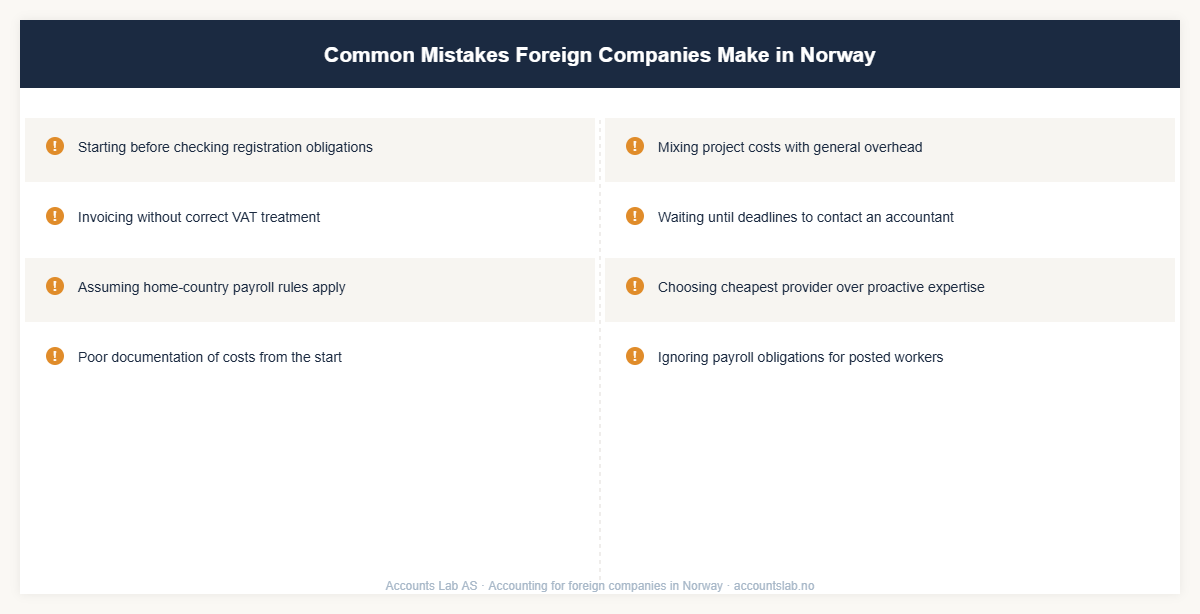
- Starting the project before checking registration obligations in Norway
- Invoicing without the correct VAT treatment — or with incorrect VAT applied
- Assuming home-country payroll arrangements are sufficient for employees working in Norway
- Failing to document costs correctly from the beginning of the project
- Mixing project-specific costs with general company overhead
- Waiting until reporting deadlines are imminent before engaging an accountant
- Choosing the cheapest accounting provider rather than one with genuine expertise in foreign company compliance
- Underestimating how quickly the administrative backlog can build
How Accounts Lab Helps Foreign Companies in Norway
Accounts Lab AS is a Norwegian statsautorisert regnskapsforetak — a state-authorised accounting firm. We work digitally and provide our services in English, making us a practical choice for international companies and management teams who need clear, reliable accounting support in Norway without language barriers.
Accounts Lab is not built as a high-volume bookkeeping factory. We work with a limited number of clients so we can provide close follow-up, clear communication, and proactive financial control.
For companies searching for accounting for foreign companies in Norway, the most important step is to clarify obligations before the project starts. We can help you do exactly that.
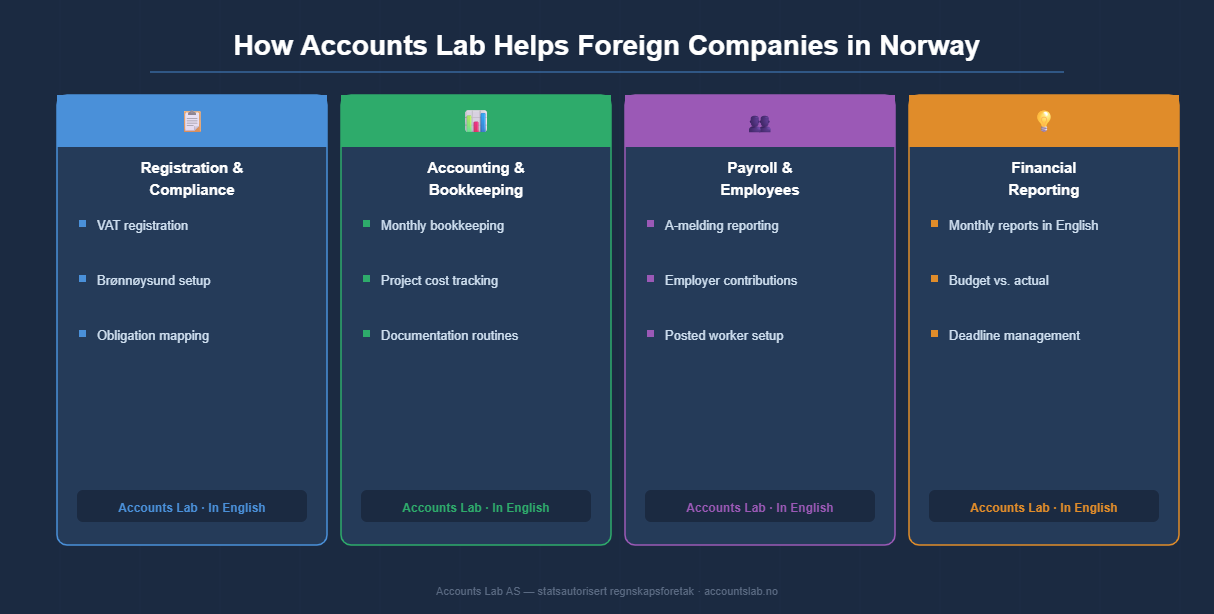
- Initial compliance assessment — understanding what registrations, reporting obligations, and structures apply to your activity in Norway
- VAT registration and ongoing MVA reporting — correct setup and timely filing
- Payroll setup and monthly processing — including A-melding reporting and employer contributions
- Bookkeeping and documentation routines — structured from the start, not reconstructed later
- Monthly financial reporting — with clear commentary in English, not just numbers
- Project profitability tracking — actual versus budget, margin monitoring, and deviation analysis
- Deadline management — so nothing is missed and no surcharges are incurred
- Ongoing advisory — a direct line to a senior authorised accountant who understands your business
Start Right. Avoid the Costly Mistakes.
Norway is a serious market, and serious companies deserve a serious accounting partner.
If you are planning a project, assignment, or expansion in Norway, the most valuable conversation you can have is one that happens before the first employee arrives or the first invoice goes out. The cost of setting things up correctly is a fraction of the cost of correcting them later.
Before you send employees, issue invoices, or sign your next Norwegian contract, talk to Accounts Lab. A short clarification now can prevent expensive cleanup later.
Contact Accounts Lab before work begins →
Frequently Asked Questions
Does a foreign company always need to register in Norway before starting a project?
Not in every case — it depends on the nature of the activity, duration, and whether employees are present in Norway. However, registration obligations should always be assessed before work starts. Operating without the required registrations creates tax and penalty exposure.
Can Accounts Lab help with both VAT registration and payroll for a foreign company?
Yes. We handle the full accounting and compliance setup for foreign companies operating in Norway, including VAT registration, MVA reporting, payroll processing, and ongoing bookkeeping — all communicated clearly in English.
How does Norwegian bookkeeping differ from what we do at home?
Norwegian bookkeeping has specific requirements around documentation standards, traceability, VAT handling, and retention periods. What is acceptable in your home country may not meet Norwegian standards. We establish compliant routines from the start so there are no surprises during a tax review.
Do you provide legal advice on company registration or employment law?
No — we are an accounting firm, not a law firm. We handle the accounting and financial compliance side. Where legal questions arise around company structure or employment matters, we will let you know and point you toward the right specialists.
What languages does Accounts Lab work in?
We work in English, Norwegian, Portuguese, and Spanish. For foreign companies and management teams, all communication, reporting, and advisory can be conducted in English.
When is the right time to contact Accounts Lab for a project in Norway?
Before the project starts — ideally before the first employee arrives and before the first invoice is issued. Early engagement allows us to set up the right structures from day one, which is always more efficient than correcting problems after they have developed.

2 Responses